Golf Rangefinder With Slope vs Without Slope
A golf rangefinder with slope gives a slope-adjusted distance for uphill and downhill shots, while one without slope shows the straight-line distance only. Pick slope if your course has real elevation changes, and skip it if you play flat ground or need one simple reading.
On this page (16 sections)
- What slope adds to the number you see
- A worked example on an uphill hole
- Who a slope model helps most
- Slope doesn't make the laser more accurate
- A quick test for your home course
- Who the 20 GIII straight-distance model suits
- What the two Nikons share besides range
- Locked On Quake and First Target Priority on the course
- Size, weather and what comes in the box
- Practicing with slope before a round
- Why some golfers skip slope
- Asking the club about slope before you play
- Can you turn slope off on the 20i GIII?
- Common mistakes with a slope reading
- The specs side by side
- Golf rangefinder with slope or without: which to buy
A golf rangefinder with slope gives you a slope-adjusted distance for uphill and downhill shots, while one without slope shows only the straight-line distance. Nikon's COOLSHOT 20i GIII and COOLSHOT 20 GIII show the choice cleanly, since they match on most other specs.
We compared the two on Nikon's specs and features. This post covers what slope adds, who needs it and why some golfers skip it.
If the feature is new to you, start with what slope is on a golf rangefinder. The golf rangefinders buying guide covers every type.
 Best for hilly or uneven courses
Nikon COOLSHOT 20i GIII Golf Rangefinder

What slope adds to the number you see
Slope mode measures the angle to the target and adjusts the distance, so an uphill or downhill shot reads as the distance it plays. It's a guide for club choice, not a promise of where the ball will land.
Golf rangefinder slope readings on a hill
Nikon calls the feature ID Technology on the 20i, and says it calculates slope-adjusted distances for uphill and downhill shots. Golf Mode is the setting that gives those slope-compensated distances.
The 20 GIII focuses on straight distance, so its reading is the line-of-sight number from you to the target. Both models measure up to 800 yd, so range isn't what separates them.
For the basics of how a reading is made, see how does a golf rangefinder work.
A worked example on an uphill hole
Say the straight-line number to the flag is 150 yd, and the flag sits well above you on a rise. The plays-like number for that shot will be longer than the straight reading, so the club you pick may change.
Downhill, the logic runs the other way, and the plays-like number comes out shorter. In both cases you still choose the club, and the slope number only tells you how the ground changes the shot.
Wind, the lie and your own swing can move the ball as much as slope does. Treat the slope number as one input to the club choice.
Who a slope model helps most
A slope model helps most on courses with real elevation changes, where an uphill or downhill shot plays differently from the number you see. Flat courses gain little from it, so a straight reading may be enough.
- Your home course has tee boxes well above or below the fairway.
- You often hit approach shots up a ridge or over a valley.
- You want the club choice to account for elevation without guessing.
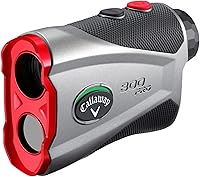
On flat ground, the slope reading and the straight-line reading are close, so the 20i's extra mode adds little. If you'd rather have an external slope switch than a mode, our Callaway 300 Pro review covers a laser that has one.
Slope doesn't make the laser more accurate
Slope changes what the number means, not how well the laser measures. The straight-line reading is still the true distance to the target, and the plays-like reading is that distance adjusted for the angle.
That's why a slope model can show two numbers for one shot. Know which one you're reading before you pick a club.
A quick test for your home course
Think about the holes you play most. If several have a green well above the fairway, a tee well above the landing area or a steep drop short of the flag, slope has work to do.
If most of your holes sit on level ground, the extra mode may sit unused. In that case the 20 GIII covers what you'd actually use.
Who the 20 GIII straight-distance model suits
The 20 GIII suits a golfer who wants one straight number and no mode to manage. It fits a flat course, a golfer who already knows how elevation affects their clubs, or a round where slope isn't part of the plan.
- You play mostly flat ground.
- You want a simple reading that doesn't change with the terrain.
- You play rounds where slope isn't allowed.
The 20 GIII keeps the same 6X optics, 800 yd range and Locked On Quake alert as the 20i. You give up the slope adjustment, but you keep the parts that help you pick out the flag.
If you're shopping on a budget, our best budget golf rangefinders post compares entry-level options, and a no-slope model is one way to keep the feature list simple.
What the two Nikons share besides range
Both models use 6X magnification with a 20mm objective, and Nikon says the multilayer-coated lenses give a bright, high-contrast view. That helps you pick out a flagstick, a bunker or a dogleg corner before you press the button.
Nikon also describes one-touch ranging, plus continuous scanning for up to 8 seconds so you can sweep across several targets and see readings in real time. Scanning helps when you want the distance to a few spots, such as the front and back of a bunker.
Neither feature depends on slope, so you get both whichever model you buy.
Locked On Quake and First Target Priority on the course
Both models use Locked On Quake to confirm a flag lock with a gentle vibration, and First Target Priority to favor the closest object. Those two features matter as much as slope when the flag sits near trees.
Nikon says Locked On Quake vibrates gently when the rangefinder locks onto the flag, so you feel the lock and your eyes stay on the target. First Target Priority matters when trees, hazards or other objects sit behind the flag, because Nikon says it keeps the reading on the closest object.
Both models share these two features, so they don't separate the 20i and the 20 GIII.
Size, weather and what comes in the box
Both models measure about 3.6 x 1.5 x 2.9 in, and Nikon says they are compact, at 4.3 ounces, and fit comfortably in one hand. Nikon also says the housing is rainproof and the grip is slip-resistant, which helps on a damp round.
Nikon backs both with a 5 year warranty. The 20i comes with a CR2 battery, and the 20 GIII comes with a battery and a case.
Size and weather resistance don't separate the two, so they won't decide your choice.
Practicing with slope before a round
Pick a spot with a clear rise or dip and take the same reading from both sides. Compare the plays-like number with where the ball finishes, so you learn when slope changes your club.
Do this on a few shots before a round that matters. The goal isn't a perfect number, but a feel for when the slope reading is worth acting on.
Why some golfers skip slope
Some golfers skip slope for three reasons: they play flat courses, they want one clear number, or they play rounds where slope isn't allowed. Each reason is about the round, not the quality of the optics.
The Rules of Golf allow distance measuring by default, and a committee can prohibit it. Slope readings aren't allowed in a round unless the committee permits them, so check the local rule.
The USGA publishes the Rules, and our are golf rangefinders legal post goes through slope in more detail.
Simplicity is the second reason. A straight-line reading has no mode to check on the tee, so there's one number to read on every target.
Asking the club about slope before you play
Before you buy a slope model for competition play, ask your club whether slope is allowed in its events. Ask the same question about any club you plan to play as a visitor.
Ask whether the local rule covers slope-measuring devices, since the answer can differ between a club event and a casual round. Get the answer in writing if you can, so you have a record for your next round.
Once you know, the choice gets simpler. A slope model that's allowed in your rounds gives you more information, and a straight model gives you one number for every shot.
Can you turn slope off on the 20i GIII?
Yes. Nikon says the 20i keeps working with Golf Mode deactivated, so it can act like a straight-distance unit on rounds that need it.
Learn how to switch Golf Mode on and off before your first round. Decide which reading you need before you tee off, since switching modes on the tee takes attention away from the shot.
Common mistakes with a slope reading
The first mistake is taking the reading to the wrong target. Aim at the flag you intend to play, not a tree or a stake beside it.
The second is trusting the slope number over the wind. A plays-like number doesn't account for a gust, so weigh the wind as well.
The third is changing modes mid-hole. Set the mode before you walk to the ball, so the number you read matches how you plan to play the shot.
The specs side by side
The table shows that range and magnification match, so slope is the spec that separates these two. Everything else is the same for both models, or the difference is the slope mode itself.
| Product | Best for | Range | Magnification | Slope | Our score |
|---|---|---|---|---|---|
| Nikon COOLSHOT 20i GIII Golf Rangefinder | hilly or uneven courses | Up to 800 yd | 6X | Yes, in Golf Mode | 8.7 |
| Nikon COOLSHOT 20 GIII Golf Rangefinder | no-slope rounds | Up to 800 yd | 6X | None, straight-line distance only | 8.1 |
Our scores weigh the specs and features above against two different buyers, one who wants elevation and one who wants a single straight number. The 20i scores higher for a golfer who plays hilly ground, and the 20 GIII scores higher for one who wants a simple reading.
Golf rangefinder with slope or without: which to buy
Buy the 20i GIII if your course has real elevation changes and you want a slope-adjusted distance on the same 6X optics. Its Golf Mode gives you the plays-like number when a hill is part of the shot.
Buy the 20 GIII if you play mostly flat ground, want one straight number, or play rounds where slope isn't allowed. It keeps the same optics and range without a slope mode to manage.
The two names differ by one letter, so confirm the "i" before you order if you want slope. Either way, check the local rule before the round, since the event or club committee decides whether slope is allowed.
If you want to see more slope models first, read best golf rangefinders with slope.
Frequently asked questions
What does slope do on a golf rangefinder?
Slope mode measures the angle to the target and gives an adjusted distance for an uphill or downhill shot. It's a guide for club choice, not a promise, and on flat ground the slope reading and the straight-line reading are close.
Is slope allowed in golf competitions?
It depends on the event. The Rules of Golf allow distance measuring by default, but slope readings aren't allowed in a round unless the committee permits them, so check the local rule or ask the committee before you play in an event.
Why would a golfer skip slope?
Some golfers play flat courses, want one clear number, or play rounds where slope isn't allowed. A straight-line reading has no mode to set on the tee, so there's one number to read on every target, which many golfers find simpler.
Can the Nikon COOLSHOT 20i GIII be used without slope?
Yes, since Nikon says the 20i keeps working with Golf Mode deactivated, so it can act like a straight-distance unit. Learn how to switch Golf Mode on and off before your first round, so you aren't setting it on the tee.
Do the 20i and 20 GIII share the same range and magnification?
Yes, both use 6X optics with a 20mm objective, measure up to 800 yd and carry the Locked On Quake alert. Slope is the main difference, so the choice comes down to whether you want the adjusted number on your hilly holes.