Are Golf Rangefinders Legal? Slope and Tournament Rules
Golf rangefinders are legal by default under the Rules of Golf, but a committee can ban them. Under the standard rules a device may measure distance only, so slope readings aren't allowed during a round unless the committee permits them, and the local rule is the one to check.
On this page (9 sections)
- Are golf rangefinders legal by default?
- What the standard rules let a device do
- Slope: the reading to check before each round
- Events and clubs set the local rule
- What the default rule does not settle
- A pre-round checklist for rangefinder rules
- Buying a rangefinder with the rules in mind
- Hunting rangefinders and the same check
- Are golf rangefinders legal at your next event?
Yes, golf rangefinders are legal by default under the Rules of Golf, unless a committee adopts a local rule that prohibits them.
The question gets specific with features. A rangefinder that shows slope, wind or temperature is still a distance-measuring device, but the standard rules limit what you can use during a round.
This page is a plain summary of the standard rules and what a committee can change. It isn't a ruling on your event or legal advice, so the rules text and your local rule are what count.
Are golf rangefinders legal by default?
Since 2019, the Rules of Golf allow distance-measuring devices by default, so you can carry and use a golf rangefinder unless a committee says otherwise. A committee can adopt a local rule that prohibits them, so one event may allow a unit that another event bans.
What the standard rules let a device do
Under the standard rules, a device may measure distance only. Using slope or gradient, wind speed or direction, or temperature readings during a round isn't allowed unless the committee permits it.
The USGA sets out the change on its page about distance-measuring devices. Read it for the exact wording.
Are golf rangefinders legal if they have slope?
A rangefinder with a slope feature is still a distance-measuring device. What the standard rules limit is using the slope reading during a round, which is why many models have a switch or a slope-off setting.
The committee can say more in a local rule, so the event notice or the pro shop has the final word.
Wind and temperature readings too
Slope gets the attention, but the standard rules also list wind speed, wind direction and temperature. A unit that shows any of these needs the same check before you play.
Some hybrids add more than slope. Blue Tees says its Captain Pro can factor wind, temperature and humidity into its distance, so check what a unit's settings include and whether you can turn each one off.
What a breach costs
Under the standard rules, a breach costs the hole in match play and two strokes in stroke play. A second breach in the same round means disqualification.
Slope: the reading to check before each round
Slope is the reading most golfers ask about, because many modern rangefinders show it. A slope switch or a slope-off setting is how a unit lets you keep that reading out of a round.
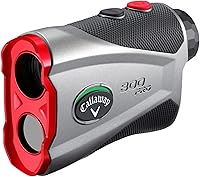
Some units use a dedicated switch. The Callaway 300 Pro and the Bushnell Tour V6 Shift both have an external slope switch.
Other units change slope through a mode. REDTIGER describes six measuring modes, and slope compensation is one of them, so confirm the mode on the display.
Blue Tees says the Series 3 Max+ has a slope switch that toggles slope on and off.
Makers often describe a slope switch as a competition feature. A maker's label doesn't decide the question, because the committee does.
Set the mode before the first tee
Confirm the setting on the display, not only from memory. Set the mode at the car or the cart before the first tee, so you're not changing it in the middle of a round.
If you realize slope was on during a round, ask the committee or a rules official what applies. The process comes from them, not from this page.
The routine for setting the mode is in how to use a golf rangefinder, step by step.
Events and clubs set the local rule
The committee for each event or club decides whether a device is allowed and which readings you may use. A local rule can prohibit distance-measuring devices altogether, so the committee may ban the rangefinder you brought.
The R&A, which writes the Rules of Golf with the USGA, has its home page at randa.org.
Local rules in plain terms
A local rule is a rule the committee adds for one event or one course. Check the event notice or the club's rules sheet before you play.
Three questions to ask first
Before an event, ask the committee these questions:
- Are distance-measuring devices allowed?
- Is slope use allowed, or must it be off?
- Does the committee require a specific setting?
Get the answers in writing where you can, such as on the event notice. A written answer is easier to point to later.
What the default rule does not settle
The default rule covers the device, not every reading it can show. A device can be allowed while one of its readings is not, and a slope switch doesn't change the local rule.
Golf rangefinder with slope vs without slope lays out how the two kinds of unit differ, and what slope is on a golf rangefinder explains the reading itself.
A pre-round checklist for rangefinder rules
Four quick checks cover most of what the rules ask of you. They take a few minutes before you leave the car.
- Read the event notice or the club's local rules for any ban on distance-measuring devices.
- Find out whether the committee permits slope or other readings.
- Set the unit to the mode your event allows, and confirm it on the display.
- Ask the pro shop or the committee if any answer isn't clear.
Do this for every event, because a local rule can change from one event to the next. The setting you used last time is not proof of what this event allows.
Buying a rangefinder with the rules in mind
If you play events, pick a unit with a slope switch or a slope-off setting, so you can keep the reading out of a round when the committee requires it. A switch you can see and reach is easier to check than a setting buried in a menu.
If you rarely play events, you can choose by features first, and a slope switch still keeps your options open. The complete buying guide covers the other features worth comparing.
Hunting rangefinders and the same check
A hunting rangefinder is also a distance-measuring device, so the same check applies if you bring one to a golf course. Golf rangefinder vs hunting rangefinder covers the key differences between the two.
Are golf rangefinders legal at your next event?
Check the local rule, decide whether you need slope, then set the unit to match the rule before you walk to the first tee.
Pick a slope model if you want the feature for practice and can switch it off when your event requires. Pick a plain laser if you don't need slope at all.
The best golf rangefinders with slope lists models with a switch.
Frequently asked questions
Can I carry a golf rangefinder in my bag?
Yes, because distance-measuring devices have been allowed by default under the Rules of Golf since 2019. A committee can adopt a local rule that prohibits them, so check the rule for your event or club before you bring one to the first tee.
Can I use slope during a round?
Not under the standard rules, because a device may measure distance only, so slope, wind and temperature readings aren't allowed during a round unless the committee permits them. Many rangefinders have a slope switch or a slope-off setting, and the local rule decides what your event requires.
What happens if I use slope by mistake?
Under the standard rules, the penalty is loss of the hole in match play and two strokes in stroke play. A second breach in the same round means disqualification, so ask the committee or a rules official how it applies to your event.
Who decides whether my rangefinder is allowed?
The committee for the event or the club decides, and it can adopt a local rule that prohibits distance-measuring devices. The answer can change from one event to the next, so ask the committee or the pro shop when you're unsure.
Does the rule apply to a hunting rangefinder?
A hunting rangefinder is also a distance-measuring device, so check the local rule for any model you bring to a golf course. The rule looks at what the device does during a round, so the name on the case doesn't change the answer.