What Is Slope on a Golf Rangefinder?
Slope on a golf rangefinder adjusts the yardage for uphill and downhill shots. The unit measures the angle to the target and shows a slope-adjusted number, so you can see how far the shot plays.
On this page (9 sections)
- What slope on a golf rangefinder does to the number
- Where slope helps most
- How slope is switched on and off
- Check the lock, the mode and the hill when a number looks off
- What slope does not change
- Slope and the rules of play
- Slope models compared with plain lasers
- How to use slope on your next round
- Should you buy a golf rangefinder with slope?
Slope on a golf rangefinder is the setting that adjusts the yardage for uphill and downhill shots.
On flat ground, the straight-line number is usually all you need. On a hill, the distance the laser measures can differ from the distance the shot plays, and slope accounts for that gap.
This guide covers what slope does, where it helps, how the on/off switch works and why the rules limit it during a round.
What slope on a golf rangefinder does to the number
Slope measures the angle from you to the target and adjusts the yardage for the change in height. The unit then shows a slope-adjusted number, which is how far the shot plays on that hill.
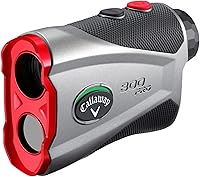
Golfers often call that number the "plays-like" distance. Callaway the 300 Pro measures the angle of incline or decline, then calculates the slope-adjusted distance.
Uphill plays longer, downhill plays shorter
An uphill shot plays longer than the straight-line number, so you need more club. A downhill shot plays shorter, so you need less club than the laser alone suggests.
Many golfers judge that adjustment by feel, and the feel can be off. Slope replaces the guess with a number based on the angle.
Here's an illustration, not a measurement from a real unit. A flag 150 yards away on a steep rise might read 158 with slope on, so you'd pick the club for 158.
How steep the hill changes the number
A steeper angle moves the adjusted yardage more than a gentle one does, even when the straight-line distance is the same. Near level ground, slope changes the number very little.
That's why a flat course gains less from the feature and a course with real elevation change gains more.
Where slope helps most
Slope helps most on hilly courses, and on shots hit up to a raised green or down to a low one. On flat ground, the straight-line number is often close enough.
Shots hit up or down to a green
When you hit up to a green, the shot plays longer than the laser says. When you hit down to one, it plays shorter, so the slope number can change which club you pick.
High tees and low greens
A par 3 hit down from a high tee plays shorter than the straight-line number, and a par 3 hit up to a raised green plays longer. Those are the holes where slope changes the club most often.
If you can see a big drop or climb between you and the target, that's your cue to check the slope reading.
Flat courses and the basic model
If your home course is flat, a slope feature adds a setting you may rarely use. A plain laser with a clear flag lock can serve you well there.
How slope is switched on and off
Slope models use either an external switch or a mode setting, so learn which one your unit uses before the first round. The steps differ by brand and by model.
Reading slope on a golf rangefinder
The Callaway 300 Pro and the Bushnell Tour V6 Shift both have an external slope switch, so you can set it before you raise the unit. The Bushnell Tour V6 Shift review covers that model in full.
REDTIGER describes a slope switch and six measuring modes, and slope compensation is one of the modes. A brief press of the button changes the mode, so check the screen before you read a number.
Blue Tees says the Series 3 Max+ toggles slope on and off with a slope switch, and its flag lock vibrates in short pulses.
Check the lock, the mode and the hill when a number looks off
Check the lock first, then the mode, then the hill you can see. Each step catches a different kind of error.
Check the lock first
Slope doesn't change the flag lock, and the slope math runs on whatever the beam hit. If the beam lands on a tree behind the pin, the slope number is wrong too.
Wait for the lock cue, and aim again if the reading jumps between two values. How does a golf rangefinder work? explains how the laser picks its target.
Check the mode second
Confirm that slope is on when you want it and off when your round requires it. A mode you forgot to change is an easy reason for a number to look strange on the first hole.
Compare the number with the hill
If the adjusted number looks far off from the hill you can see, measure again from a second spot. A second reading shows whether the first one was a fluke or a real change in elevation.
What slope does not change
Slope changes only the number on the screen. It doesn't change the range, the magnification or the flag lock.
A slope model has the same range limit with slope on or off, and the feature can't fix an aim at the wrong object.
Slope and the rules of play
Under the standard Rules of Golf, a device may measure distance only, so slope readings aren't allowed during a round unless the committee permits them. Events and clubs can also adopt a local rule, and a committee can prohibit distance-measuring devices altogether.
That's why most slope models have a switch or a slope-off setting. Are golf rangefinders legal? covers the rule, the penalty and the questions to ask your committee.
Slope models compared with plain lasers
A plain laser gives the straight-line number only, while a slope model adds an angle reading and a way to switch it off.
If your course has hills and you can switch slope off for events, a slope model gives you more options. If your rounds stay flat, the extra setting may not earn its keep.
Golf rangefinder with slope vs without slope compares the two side by side. The best golf rangefinders with slope lists the models that include the feature.
How to use slope on your next round
Check the mode, read the slope number and pick the club from it only if your round allows slope.
Practice with slope on for a few holes so you learn how the number moves on your own hills. Then switch it off for any round that doesn't allow it.
The full routine, including how to lock the flag, is in how to use a golf rangefinder, step by step.
A practice round on a hill
Pick a hilly hole and hit to the flag twice, once with the straight-line number and once with slope. Compare each club choice with the shot you hit, and note which number matched the result.
Should you buy a golf rangefinder with slope?
Pick a slope model if your course has real hills and you can switch slope off for events. Pick a plain laser if your rounds stay flat and you want a simpler unit.
Check how the switch or mode works before you buy, since that setting decides how easy slope is to control. The complete buying guide to golf rangefinders covers every other feature in one place.
Frequently asked questions
What does slope do on a golf rangefinder?
Slope measures the angle to the target and adjusts the yardage for the change in height, so an uphill target plays longer and a downhill target plays shorter. The unit shows the slope-adjusted yardage, so you can choose a club for the shot as it plays.
Does slope make a golf rangefinder more accurate?
Slope changes the number the unit shows, not the laser's own accuracy, because the adjustment is only as good as the reading behind it. A laser that lands on a tree gives a wrong number with or without slope, so the flag lock matters just as much.
Is slope allowed during a round?
Under the standard Rules of Golf, a device may measure distance only, so slope readings aren't allowed during a round unless the committee permits them. A committee can also set its own local rule, so check the rule for your event before you play.
How do I turn slope on or off?
It depends on the model, since the Callaway 300 Pro and the Bushnell Tour V6 Shift have an external slope switch and REDTIGER describes a slope switch plus six measuring modes. Read the quick-start guide for your unit before you head out.
Do I need slope on a flat course?
Usually not, because on flat ground the straight-line number sits close to the distance the shot plays, so a plain laser may serve you well. Slope earns its place on hilly courses and on shots hit up to a raised green or down to a low one.