Golf Rangefinders: The Complete Buying Guide
A golf rangefinder is a handheld laser that gives you the exact yardage to the flag. Many models also add slope, which adjusts that number for uphill and downhill shots, so decide whether you want it before you buy.
On this page (12 sections)
- Laser or GPS: the basic difference
- The specs that matter most when you compare lasers
- Slope, stabilization and the features that change your number
- Bushnell, Callaway, Nikon and REDTIGER: brand by brand
- GPS handhelds and hybrids
- Rules: slope, events and what you can use
- Budget, mid-range and premium golf rangefinder tiers
- Who a golf rangefinder suits, and buying one as a gift
- Accessories: cases, mounts and cart setup
- Questions to answer before you order
- How to use a golf rangefinder on the course
- Which golf rangefinder to buy first
A golf rangefinder gives you the distance to the flag, a tree or a bunker with one press of a button. That number helps you pick a club, and it takes most of the guesswork out of an approach shot.
This is the main guide to golf rangefinders on this site. It covers laser and GPS choices, slope, image stabilization, brands, the rules, price tiers and accessories, and it links to a deeper guide on each topic.
Many golfers buy a rangefinder as a gift. The same checklist works whether the unit is for you or for someone else.
We compared the specs for each model named here and read what the makers say about their features. Each linked guide goes deeper on one model, one question or one buying choice.
Laser or GPS: the basic difference
A laser rangefinder measures the distance to whatever you aim at, so it gives the exact yardage to the flag. A GPS device works from a course map, so it shows the front, middle and back of the green without any aiming.
| Tool | What it shows | Needs aiming at the flag | Best fit |
|---|---|---|---|
| Laser rangefinder | Exact yardage to the target you aim at | Yes | The flag number on every shot |
| GPS handheld | Front, middle and back of the green, plus the layout | No | A course view on a bigger screen |
| GPS watch | Green yardages on your wrist | No | No device in your hand |
| Hybrid | Laser yardage and GPS yardage in one unit | Only for the laser part | One device for both jobs |
For a closer look at the parts and the process, read how a golf rangefinder works.
What a golf rangefinder laser reads that a map cannot
A laser sends out a light pulse and times how long it takes to bounce back from the target. It reads whatever you point at, whether that's the flag, a tree behind the green or the lip of a bunker.
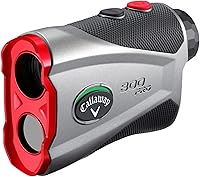
Callaway says the 300 Pro is accurate to ±1 yard. Treat any accuracy figure as the maker's claim, since the reading still depends on what you aim at.
Before you compare models, check three things: the range you need, the magnification and how the unit confirms a lock on the flag.
Where GPS fits in
A GPS unit shows yardages to the front, middle and back of the green from a stored course map. You don't need to aim, so you can glance at the distances while you walk to your ball.
The trade-off is that GPS gives you the green, not the exact position of the flag. For the number to the pin, you still need a laser.
If you want those numbers on your wrist, golf rangefinder vs GPS watch compares the two in detail. The best golf GPS watches sorts the watches by how you play.
A phone app can also show yardages, and the app versus a real rangefinder explains what changes when you rely on one.
Watch or handheld for GPS
A watch keeps the yardage on your wrist, so you never dig for the unit. A handheld has a bigger screen, which makes it easier to see more of the hole at once.
Golfers who like to study the green from a distance may prefer the bigger screen. Golfers who glance down once a shot may prefer the watch.
The specs that matter most when you compare lasers
Range, magnification and the flag lock do most of the work on the course, so compare those three before the smaller features. The rest of the feature list rarely decides the purchase by itself.
Range and magnification
Range is the longest distance the unit will measure. Bushnell says the Tour V6 Shift reaches 1,300 yards, and Callaway says the 300 Pro measures 5 to 1,000 yards.
Magnification sets how large the flag looks in the window. The Callaway 300 Pro, the Bushnell Tour V6 Shift and the Nikon PROIII Stabilized all magnify 6X, and the REDTIGER magnifies 7X, so its view is a little larger.
Range only helps if the unit can lock onto the flag at that distance. Callaway says the 300 Pro's Pin Acquisition Technology locks onto the pin up to 300 yards away.
Flag lock and vibration
A lock signal tells you the unit has the flag and not the tree behind it. Callaway's Pulse feature sends short vibrating bursts, and Bushnell's Visual JOLT pairs a flashing red ring with vibration.
Nikon's Dual Locked On Quake gives a visual and a tactile cue when the pin is locked, which matters when trees and carts sit behind the flag. Practice the cue on a few shots before your first round, then aim at the flag stick itself and wait for the cue before you read the number.
Size and carry
Size matters most when the unit rides in a pocket or on a belt all day. The Callaway 300 Pro measures 4 by 2.7 by 1.4 inches and the REDTIGER measures 4.17 by 1.61 by 2.36 inches.
A good case and a clip you can reach matter more than a fraction of an inch, so check those before you pick the smallest model.
Battery or USB-C charging
Some units run on a replaceable battery and others charge over USB-C. The REDTIGER charges over USB-C, and the Callaway 300 Pro comes with a battery included.
Decide which you'd rather manage. A rechargeable unit needs a charging habit, while a battery unit needs a spare in the bag.
What comes in the box
Cases and clips vary by unit. The Callaway 300 Pro comes with a case, a lens cloth and a quick-start guide, and the Bushnell Tour V6 Shift comes with a premium carry case, a microfiber cloth and a quick-start guide.
The REDTIGER's box includes a magnetic belt clip, a buckle, a hand rope and a user manual.
Warranty terms
Warranties differ by brand. Bushnell backs the Tour V6 Shift with a 2-year manufacturer warranty, REDTIGER says it provides 2 years of assurance, Nikon gives the PROIII Stabilized a 5-year warranty and Garmin gives the Approach Z82 a 1-year limited warranty.
Water resistance codes
IP codes tell you how much water the housing can handle. The Callaway 300 Pro carries an IPX4 rating, and Garmin's Approach Z82 laser-GPS unit carries IPX7, a higher level of water protection.
If you play in heavy rain, check the water rating for your model on the box or in the manual before you rely on it.
Slope, stabilization and the features that change your number
Slope adjusts the yardage for uphill and downhill shots, and image stabilization gives a steadier view so the flag is easier to find. Decide whether your course needs each one before you pay for it, because a plain laser handles the basic job well.
Slope: the number that changes on hills
Slope measures the angle to the target and adjusts the yardage, so an uphill shot plays longer and a downhill shot plays shorter. Courses with real elevation change are where slope earns its place.
What is slope on a golf rangefinder? explains the idea with a simple example. A slope model compared with a plain laser shows what the feature adds, and the best golf rangefinders with slope lists the models that include it.
REDTIGER says its slope model has six measuring modes, and slope compensation is one of them. A brief press of its button moves through the modes, so check the display before you read the number.
Image stabilization: a steadier view
Image stabilization counters hand shake, so the view stays steadier while you hold the unit. Nikon says image stabilization on the PROIII Stabilized keeps both the view and the laser steady.
Stabilization is one feature among several, so weigh it against range, the lock and the carry options. The best golf rangefinders with image stabilization compares the models that offer it.
Nikon and the no-slope setting
Nikon gives the PROIII Stabilized two modes: Golf Mode with slope and a no-slope option it calls Actual Distance Mode. That split works like a slope switch, just set in a different way.
Read the mode name before each round, not only the first time you use the unit.
Bushnell, Callaway, Nikon and REDTIGER: brand by brand
Bushnell has the most guides on this site, from reviews to battery and setup help, while Callaway and REDTIGER each have a review. Brand matters less than the features on your list, but the guides show how each line fits together.
Bushnell: the Tour V6 Shift and the wider line
The Bushnell Tour V6 Shift adds slope to a 1,300 yard laser. A red ring flashes and the unit vibrates when it locks onto the flag, and an external switch turns slope on or off.
The Bushnell Tour V6 Shift review goes deeper on that model, and the V6 Shift versus V7 Shift comparison shows what changed between them. If you're choosing among Bushnell models, the best Bushnell golf rangefinders sorts the line one model at a time.
Bushnell setup: use, battery and fixes
Four short guides cover the basics of owning a Bushnell rangefinder.
How to use a Bushnell golf rangefinder on the course covers the routine from the first tee. The Bushnell golf rangefinder battery guide explains the battery type and how to swap it.
If the unit stops responding, the not working guide lists easy fixes to try first. If your unit shows meters and you want yards, the meters to yards switch walks through the change.
Callaway and REDTIGER as other options
Callaway's 300 Pro has an external slope on/off switch and a magnetic cart mount, so it covers several of the same features as the Bushnell V6 Shift. The Callaway 300 Pro review goes through it in detail.
REDTIGER's slope model adds USB-C charging and a magnetic belt clip. The REDTIGER review covers it closely if it's on your shortlist.
GPS handhelds and hybrids
A GPS handheld shows course yardages on a screen, and a hybrid adds a laser to the same device. The choice comes down to whether you want the exact flag number and the green layout on one unit, or two tools that each do one job.
The Bushnell Phantom 3 Slope Golf GPS review covers a GPS handheld with a touchscreen and a built-in cart magnet.
For the exact number to a flag, a GPS handheld still needs a laser or a hybrid that includes one. A golf rangefinder with GPS explains when a hybrid is the better buy.
Rules: slope, events and what you can use
Since 2019, the Rules of Golf allow distance-measuring devices by default, and a committee can adopt a local rule that prohibits them. Under the standard rules a device may measure distance only, so slope, wind and temperature readings aren't allowed during a round unless the committee permits them.
For the rule text, start at the USGA home page or the R&A at randa.org. Are golf rangefinders legal? explains the rule, what a breach costs and what to check before an event.
Slope on or off for play
Many models include a slope switch or a slope-off setting for this reason. Check the local rule for your event or club, and ask the pro shop if you're unsure.
The committee decides what is allowed, not the maker of the unit.
Hunting rangefinders need the same check
A hunting rangefinder is also a distance-measuring device, so the same check applies if you bring one to the golf course. Golf rangefinder vs hunting rangefinder sets out how the two kinds of unit differ.
Budget, mid-range and premium golf rangefinder tiers
Budget, mid-range and premium describe price tiers, not features, so start with what you need and then pick the tier that covers it. A higher tier is not always the better fit.
A budget model that covers the basics
A budget model should still give you a clear display, a reliable flag lock and a case. The best budget golf rangefinders that still work well sorts the options that cover those three.
Features that justify a higher tier
Stabilization, a GPS layer and a longer range are the usual reasons to move up a tier. If you won't use any of them, a mid-range or budget unit may do the job.
The best golf rangefinders for the money compares value across the tiers.
Who a golf rangefinder suits, and buying one as a gift
A rangefinder is worth it if you play often or play courses you don't know, and it's a safe gift when you know the golfer's setup. The notes below cover whether you need one, a shortlist for older golfers and how to buy for someone else.
Is a rangefinder worth it at all
Some golfers manage well with a yardage book and a phone, so a rangefinder isn't a must for everyone. Is a golf rangefinder worth it? asks the questions that help you decide.
A shortlist for older golfers
If you're shopping for an older golfer, the best golf rangefinders for seniors and older golfers narrows the choice by features such as stabilization, size and lock cues.
Buying as a gift
A gift works best when you know the golfer's setup. Ask whether they ride in a cart or carry a bag, and whether they already wear a GPS watch.
Slope is the feature to ask about, since a golfer who plays events may need to switch it off. A case or a magnetic mount makes a useful add-on.
Accessories: cases, mounts and cart setup
A magnetic mount keeps the unit within reach on a cart, and a hard case protects the lens and buttons when it rides in a bag.
Those two accessories cover most of the setup for a new owner. Best golf rangefinder cases and magnetic holders lists the options for both jobs.
Magnets only work on metal
A cart magnet holds on a steel bar but does nothing on plastic or wood. Check the bar before you rely on a magnet for the whole round.
Some GPS units skip the magnet on purpose. MILESEEY says its G1 has none because a magnet could interfere with the GPS, and it sells a magnetic case separately.
Mounting on a cart or bag
A cart mount works best on a metal bar within reach from the driver's seat or from the walking side. How to attach a rangefinder to a golf bag or cart walks through the setup options for each spot.
Questions to answer before you order
Answer five questions about your course and your habits, and the list of models gets short quickly. Each question points to the feature that answers it.
How far do you need to reach?
Look at the longest approach you hit from your normal tees. Choose a range that covers that distance with room to spare, rather than the biggest number on the box.
A far flag is harder to lock than a close one, so check the lock range along with the maximum range.
Will you play hills?
If your course has real elevation change, slope earns its place. If it's flat, a plain laser may serve you well, and you can skip the switch.
Do you want the course on the screen?
A GPS layer shows the green's layout and the front, middle and back yardages. If you only want the flag number, you don't need that layer.
Where will it ride?
Think about the cart bar, your bag and your belt, then choose a unit that works in the places you use most. A magnet suits a cart, a clip suits a belt and a case suits a bag.
What price tier fits?
Set a price tier before you shop, then compare features inside that tier. If a feature you need sits one tier up, decide whether it's worth the step.
How to use a golf rangefinder on the course
Aim at the flag, wait for the lock signal, read the yardage, then check the slope reading if your unit has one and your round allows it. The full routine, in order, is in how to use a golf rangefinder, step by step.
Lock the flag, not the background
Aim at the flag itself, then wait for the lock cue. A short vibration burst or a flashing ring tells you the unit has the flag and not what sits behind it.
Read the mode before the number
Check which mode is on before you read the yardage. On a hill, a slope-adjusted number and a straight-line number can differ by several yards.
Which golf rangefinder to buy first
Start with the one feature you can't do without, then let the rest of your list decide between close models. Use these rules to match a unit to your round.
- Pick a plain laser if you want the flag number without extras.
- Pick a slope model if your course has real hills.
- Pick a GPS hybrid if you also want the course layout on the same unit.
- Pick a stabilized model if the view jumps when you hold the unit.
- Pick a budget model if your list has only the basics.
Before you order, read how to choose your first golf rangefinder for a short checklist.
Frequently asked questions
What is a golf rangefinder?
A golf rangefinder is a handheld device that uses a laser to measure the distance to a flag, tree or hazard and shows the yardage in a small window. Many models vibrate or flash when the laser locks onto the flag, and some add slope or image stabilization.
Is a golf rangefinder better than a GPS watch?
It depends on the number you want. A laser gives the exact yardage to the flag you aim at, while a GPS watch shows the front, middle and back of the green, and some golfers carry both or buy a hybrid that does both jobs.
Do I need slope on a golf rangefinder?
You need slope if your course has real elevation change, because it adjusts the yardage for uphill and downhill shots. Slope readings aren't allowed during a round under the standard rules unless the committee permits them, so a model with a slope switch lets you turn it off.
Are golf rangefinders allowed in tournaments?
Distance-measuring devices are allowed by default under the Rules of Golf, but a committee can adopt a local rule that prohibits them. Under the standard rules a device may measure distance only, so check the local rule for your event.
How much should I spend on a golf rangefinder?
Start with the features you need, then pick the price tier that covers them. Budget models cover the basics, while mid-range and premium models often add slope, stabilization, GPS or a bigger display, so a higher tier pays off only if you'll use what it adds.