Golf Rangefinder vs GPS Watch: Which Should You Buy?
A golf rangefinder reads the distance to whatever you aim at, and a GPS watch shows front, middle and back yardages from a course map. Pick the rangefinder for exact flag distance, and the watch if you also want hole layouts and score tracking on your wrist.
On this page (11 sections)
- Where a golf rangefinder pulls ahead
- Where a GPS watch pulls ahead
- How the way you get around the course changes the choice
- Three shots that show which device earns its place
- What each device can't do
- Charging, carrying and care for each device
- The specs side by side
- Who should buy the Callaway 300 Pro
- Who should buy the Garmin Approach S44
- Can you use both on the same round?
- Which to buy: a golf rangefinder or a GPS watch
A golf rangefinder gives you the exact distance to the flag or any target you aim at, while a GPS watch gives you front, middle and back yardages from a stored course map. The right pick depends on which number you're missing.
We compared the Callaway 300 Pro laser and the Garmin Approach S44 watch on their specs and features. If you're new to the category, start with the golf rangefinders buying guide for the basics.
 Best for score tracking and course maps
Garmin Approach S44 Golf GPS Watch
Where a golf rangefinder pulls ahead
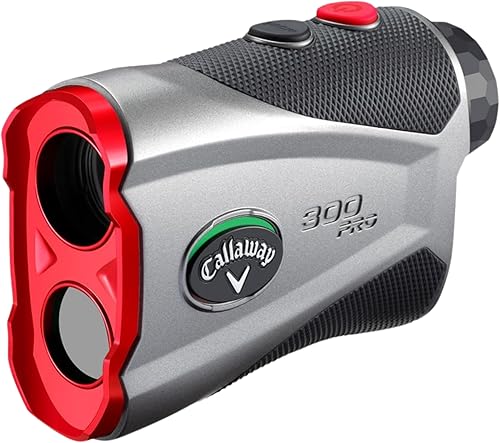
A laser wins when you need the exact distance to a flag, a bunker edge or a single tree. The Callaway 300 Pro is built for that one reading, and the number belongs to the thing you aim at.
Callaway says the unit reads from 5 to 1,000 yd, works in yards or meters, and holds an accuracy of plus or minus 1 yard. It also has 6X magnification, so the flag is easier to pick out before you press the button.
Why a golf rangefinder reads the flag directly, unlike a GPS watch
A GPS watch works from a course map that someone has already built. A laser works from the target in front of you, so the reading is for the object you chose and not a point on the map.
Callaway says its Pin Acquisition Technology lets you lock onto the pin up to 300 yd away. A pulse feature sends a short vibrating burst when the reading is confirmed, so you know the lock took.
If laser use is new to you, the step-by-step guide to using a golf rangefinder walks through aiming and the flag lock.
Slope and the cart mount on the 300 Pro
Slope is the other reason to pick a laser. The unit measures the up or down angle to the target and gives you a slope-adjusted distance, which can change your club on a hilly hole.
An external switch turns slope on or off, so you can switch it off when a local rule doesn't allow it. The Magnahold mount has a strong built-in magnet that holds the unit to the cart frame between shots.
Not every laser suits golf, because hunting models are built for a different job. Our golf rangefinder vs hunting rangefinder comparison explains the gap in plain terms.
Where a GPS watch pulls ahead
A GPS watch wins when you want the hole layout, the green yardages and score tracking in one place on your wrist. The Approach S44 covers all three, and you never have to aim it.
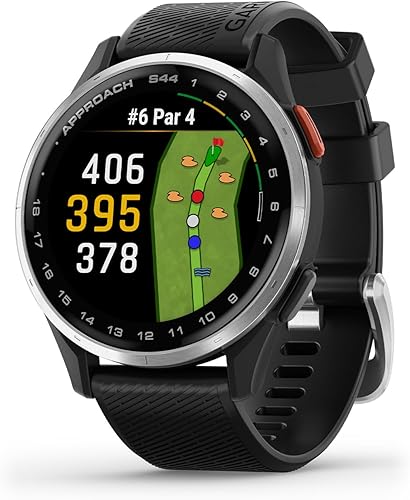
The watch has a 1.2 in color AMOLED display and carries more than 43,000 preloaded courses. You get front, middle and back distances to the green, plus a hazard view for bunkers, water hazards and layups.
You can keep score on the watch and upload it to the Garmin Golf app for stat tracking and a handicap calculation. Pair it with a phone and emails, texts and alerts reach your wrist, so the phone can stay in the cart.
CourseView maps, green contour data, PlaysLike Distance and Touch Targeting come with a Garmin Golf membership. The front, middle and back yardages don't need it, so you can decide on the extras later.
The Approach CT1 and CT10 club trackers add shot tracking and are sold separately.
If you'd rather have a handheld unit than a watch, our Bushnell Phantom 3 Slope GPS review covers that route. For more wrist options, see best golf GPS watches for everyday golfers.
How the way you get around the course changes the choice
Start with how you move, because a laser and a watch fit a walker and a cart rider differently. The answer often settles the choice before specs do.
If you walk, the watch is already on your wrist for every hole, while a laser lives in a pocket or bag between targets. A cart rider can stick the laser to the cart frame, so it stays close at hand for each shot.
Each laser reading takes an aim and a press. The watch needs only a glance, which suits a faster pace on the easy holes.
Three shots that show which device earns its place
On a blind approach the watch helps more, and on a flag tucked behind a bunker the laser helps more. Three common shots make the split clear.
Take a blind approach over a rise. The watch shows the front, middle and back of the green, and Garmin says PinPointer helps you line up the shot when you can't see the green.
Now take a flag tucked behind a bunker. The laser reads the flag you aim at, so the number follows the pin and not the center of the green.
Last, take a layup in front of water. The watch has a hazard view, so you see the water on the screen before you pick a club, while the laser needs you to aim at the hazard edge with a clear line of sight.
On a dogleg tee shot, the watch gives you yardages to the green, hazards and doglegs before you swing. The laser only helps if you can see a target at the corner to aim at.
Neither device replaces your own judgment about the club.
What each device can't do
A laser can't see around a corner, and a watch can't read the object you point at. Knowing each limit helps you decide which gap hurts you more.
The laser needs a clear line of sight and a steady aim, so a blind shot over a rise gives it nothing to read. The watch fills that gap with a stored map of the hole.
The watch reads points on that map, such as the front, middle and back of the green, so it doesn't know where today's pin sits. Garmin says a membership adds Touch Targeting, which gives the distance to any point you pick on the screen.
That gets closer to a laser's flexibility, but it's still a point on a map and not a reading off the target itself.
Charging, carrying and care for each device
The Approach S44 comes with a charging and data cable, and it connects to your phone over Bluetooth for notifications and score uploads. Plan a charge the night before a long round.
The 300 Pro comes with a molded hard case, a lens cloth and a quick start guide. The case has a carabiner and an elastic quick-close band, so it clips to a bag, and you should keep the lens clean since it's the part you look through.
Callaway says units sold in the US come with a battery included, but it doesn't state a run time. Check the battery before a trip, and keep the unit in the case during heavy rain.
The specs side by side
The table compares what each device does, how it finds distance and how its battery works. Garmin is the only one of the two that states a battery run time.
| Product | Best for | Type | How it measures | Battery | Our score |
|---|---|---|---|---|---|
| Callaway 300 Pro Golf Laser Rangefinder | flag yardage | Golf laser rangefinder | Laser, 5 to 1,000 yd | Lithium, included in the US | 8.5 |
| Garmin Approach S44 Golf GPS Watch | score tracking and course maps | Golf GPS smartwatch | GPS, front, middle and back of green | Up to 15 hours in GPS mode | 8.3 |
Our scores weigh specs and features against the job each device does. The Callaway scores higher for a golfer who wants the flag, and the Garmin scores higher for one who wants course data.
Who should buy the Callaway 300 Pro
Buy the 300 Pro if you want the last few yards to the flag and don't need hole maps on your wrist. It fits you if any of these sound like your round.
- You want the exact distance to a flag, a bunker edge or a single tree.
- You want a magnet that holds the unit to the cart frame.
- You want slope on and off with an external switch you can reach without a menu.
The 300 Pro measures 4 in long, 2.7 in wide and 1.4 in high. Callaway points buyers to its website for warranty details, so check the Callaway site if that matters to you.
If a phone app is your plan today, our app versus real rangefinder comparison explains where a dedicated laser pulls ahead.
Who should buy the Garmin Approach S44
Buy the Approach S44 if you want hole layouts, score tracking and notifications on a watch you already wear. It gives you GPS yardages, but not a laser reading to one chosen target.
- You want front, middle and back distances on every hole.
- You want scores uploaded for stat tracking.
- You want emails, texts and alerts on your wrist while the phone stays in the cart.
The watch has a 43mm black case and a 20 mm silicone band. Garmin says the bright AMOLED display makes key yardages easy to see, and the watch works with iPhone and Android phones.
If you don't wear a watch today, try the case on before you commit. You'll wear it for every round, so fit matters as much as the screen.
Can you use both on the same round?
Yes, and the two devices don't overlap much. The watch carries the hole, and the laser handles the final reading to a flag or a target you pick.
A simple routine is to let the watch plan the hole from the tee, then use the laser for the flag on your approach. Using both adds one more thing to charge, so check both before you leave.
If you'd rather carry one device for both jobs, our hybrid guide asks whether a combined unit is worth it.
The Rules of Golf allow distance measuring by default, and a committee can prohibit it. Slope readings aren't allowed in a round unless the committee permits them, so check the local rule.
The USGA publishes the Rules of Golf, and our legal rules post explains how slope fits in.
Which to buy: a golf rangefinder or a GPS watch
Pick the Callaway 300 Pro if flag distance is the number you're missing and you don't need course maps. It's the better buy when slope matters and a second item in the bag is fine.
Pick the Garmin Approach S44 if you want hole layouts, score tracking and notifications on your wrist. It's the better buy when you'd rather carry one device that covers the course, the score and your messages.
Buy both if you play often and want the flag reading and the hole view on the same round.
If you're still unsure that a laser is worth the money, read is a golf rangefinder worth it before you spend.
Frequently asked questions
Is a GPS watch as accurate as a golf rangefinder?
For one flag or target, a laser rangefinder is the more direct tool, because it measures to the object you aim at. A GPS watch reads yardages to points on a stored course map, which suits greens and hazards, while Callaway says the 300 Pro is accurate to plus or minus 1 yard.
Does the Garmin Approach S44 need a phone to work?
No, not for yardages or scoring, since the watch has built-in GPS and keeps score on its own. Pairing it with an iPhone or Android phone adds emails, texts and alerts, and lets you upload scores to the Garmin Golf app for stat tracking and handicap calculation.
Can a golf rangefinder ride on a golf cart?
Yes, the Callaway 300 Pro has a Magnahold mount with a strong built-in magnet that holds it to the cart frame between shots, so it stays within reach on every hole. The Garmin Approach S44 stays on your wrist, so it needs no mount at all.
Should I buy a GPS watch if I already own a rangefinder?
Only if you want hole layouts, hazard views and score tracking on your wrist, since a rangefinder already gives a precise reading to the flag. The watch is a second device to charge, so compare the hole view against that extra step.
How long does the Garmin Approach S44 battery last?
Garmin says the watch runs up to 15 hours in GPS mode, and the battery takes 30 minutes to charge. Real run time depends on how often you use GPS, notifications and the display, so charge it before a long day on the course.