Golf Rangefinder App vs a Real Rangefinder
A golf rangefinder app is enough for a casual round on flat, familiar ground, but a dedicated device is worth it when you want a reading to the flag, slope or a phone that stays in the bag. Pick the app for convenience, and a dedicated laser or GPS unit for a target-specific reading.
On this page (14 sections)
- What a golf rangefinder app does well
- Where a phone app falls short
- Where a laser rangefinder wins
- Where a GPS unit like the Phantom 3 fits
- Battery, signal and the phone in your hand
- Who an app suits and who needs a device
- A round with each option
- Three questions that decide it
- The specs side by side
- How each option handles slope
- Setup and care for a dedicated unit
- When a basic app is enough
- When a dedicated device is worth buying
- Golf rangefinder app or a real device: which to choose
A golf rangefinder app is enough for casual rounds on familiar courses, but a dedicated laser or GPS unit is worth buying when you want the exact distance to a flag, slope, or a phone that stays in your bag. The right pick depends on how you play.
We compared how a phone app works in general terms against the REDTIGER Golf Rangefinder With Slope and the Bushnell Phantom 3 Slope Golf GPS. We don't name specific apps, because apps change often.
If you're still asking whether a device is worth buying at all, read is a golf rangefinder worth it first. The golf rangefinders buying guide covers each type in more depth.
 Best for a belt-clip laser with slope
REDTIGER Golf Rangefinder With Slope

What a golf rangefinder app does well
A phone app is strong on convenience, because you already carry the phone and you don't need to buy a device. Most golf apps use the phone's GPS and a course map to show yardages to the green.
The trade-off is the phone itself. It has to stay charged, stay in reach and hold the course map you need for the round.
Many apps also bring the scorecard and the hole layout into one place. For a golfer who wants a simple view of the hole, that can be enough.
Where a phone app falls short
An app gives you a map reading, so it can't pick out one flag or tree the way a laser can. The yardage comes from the mapped green, not from the object you aim at.
Golf rangefinder app readings against a real laser
A laser reads the object you point at, and that is the main reason a golfer buys one. An app reads the course map, which is accurate enough for many rounds but less direct for a specific target.
Phone use also raises practical issues on the course. The phone has to stay charged, it can take a hit in a cart or a bag, and it may lose its signal in some areas.
The Rules of Golf allow distance measuring by default, and a committee can prohibit it. Features beyond distance, such as slope readings, aren't allowed in a round unless the committee permits them, and that applies to apps too.
The USGA publishes the Rules, so check the local rule before an event.
Where a laser rangefinder wins
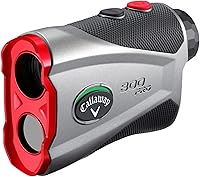
A laser wins when you want the distance to one target, such as a pin, a bunker edge or a lone tree. The REDTIGER reads the object you aim at, so the reading belongs to that target.
The REDTIGER has six measuring modes, including flag locking, slope compensation and continuous scan measurement. Its flag lock gives a vibration when the unit locks onto the pin.
REDTIGER says the unit reads with 0.5 yd accuracy, and its 7X magnification helps the flag stand out in the view. The range figure varies between sources, so check the box or manual before you rely on a top number.
Its modes also include horizontal and height ranging and speed measuring, which most golfers won't use. A switch turns slope on or off, so you choose the mode for the round.
A magnetic strip and a magnetic belt clip help keep the unit at hand on the cart or your belt. The box also includes a hand rope and a portable soft case.
Where a GPS unit like the Phantom 3 fits
A GPS unit sits between the app and the laser. It has its own battery, more than 38,000 preloaded courses and a touchscreen, but it reads mapped points rather than a target you choose.
The Phantom 3 gives front, center and back distances on the hole, and its touchscreen recognizes the hole automatically. Bushnell also describes automatic score prompts and automatic course updates, plus GreenView with moveable pin placement, so you can set where the pin sits on the green.
Bushnell says one charge lasts several rounds, and the unit has a BITE magnetic cart mount. It's still an extra device next to your phone, though.
Our Bushnell Phantom 3 review covers it in more detail. If you'd rather wear the distances, our golf rangefinder vs GPS watch comparison puts the wrist option next to a laser, and the best golf GPS watch picks show more of them.
Battery, signal and the phone in your hand
An app uses your phone's battery, and it can need a signal for course data, depending on the app. That same battery covers calls and photos on the course, which is one more reason to protect it.
A dedicated device runs on its own battery, so the phone can stay in the bag.
Carry a charger or a power bank if you plan to use the app for a full round, and check the battery before you leave. A dedicated unit needs charging too, and the REDTIGER uses USB-C.
Keep the charging cable with the device, so a flat battery doesn't end the round early. If you use both, let the device handle the yardage and the phone handle the scorecard.
Who an app suits and who needs a device
An app suits a golfer who plays a few casual rounds a year and already carries the phone. It also suits a player who wants the hole layout and scorecard in one place without buying another gadget.
A dedicated device suits a golfer who wants a reading to a specific flag, slope on and off, or a phone that stays in the bag. Those are the tasks where a laser or a GPS unit pulls ahead.
If you ride a cart, the magnetic mounts help, and the Phantom 3 is built for the cart bar. If you walk, the REDTIGER's magnetic belt clip keeps it close at hand.
A round with each option
Picture the same 18 holes three ways. With the app, you pull out the phone on each tee, read the front, middle and back numbers, and put it away.
With the REDTIGER, you aim at the flag, feel the vibration when it locks and read the number. With the Phantom 3, the touchscreen recognizes the hole and the distances are already on the screen.
Each one gets you a yardage. What changes is how many steps it takes, whether the number is for the flag or the green, and whether your phone stays in your pocket.
Three questions that decide it
These three questions settle most choices in a minute.
- Do you need the distance to the flag, or to the green? A laser reads the flag, and an app or GPS unit reads mapped points on the green.
- Do you want slope? The REDTIGER and the Phantom 3 both describe it, and app support varies.
- Do you want your phone left alone? A dedicated device has its own battery.
If you answer "the green, no and no," the app is probably enough.
The specs side by side
The table compares how each device measures, how its slope feature works and how its battery is charged. The laser measures to the target you aim at, and the GPS unit measures to the mapped green.
| Product | Best for | How it measures | Slope | Battery | Our score |
|---|---|---|---|---|---|
| REDTIGER Golf Rangefinder With Slope | a belt-clip laser with slope | Laser to the flag or any target | Switch turns slope on or off | Rechargeable lithium-ion, USB-C | 7.9 |
| Bushnell Phantom 3 Slope Golf GPS | touchscreen hole maps | GPS to mapped greens on 38,000+ courses | Slope-adjusted GPS distances | Rechargeable, several rounds per charge | 8.5 |
Our scores weigh specs and features against a golfer who wants a dedicated tool for the course. The Phantom 3 scores higher for a golfer who wants the hole on a screen, and the REDTIGER scores higher for one who wants a reading to a single target.
How each option handles slope
Slope is often the feature that separates a dedicated device from a basic app, because it changes the number you read on a hill. Slope mode measures the angle to the target and adjusts the distance, which helps with club choice on a hilly hole.
On the REDTIGER, the slope switch turns the mode on or off, so you decide before the round. The Phantom 3 gives slope-adjusted GPS distances, which Bushnell says calculate incline and decline for each yardage.
Slope support varies by app, so check what yours offers before you count on it. The slope rules apply to every option, so check the local rule before you use the mode in an event.
Setup and care for a dedicated unit
A dedicated unit needs a charged battery, a clean lens and a case, and setup takes only a few minutes at home. Do it the night before a round, not in the parking lot.
The REDTIGER comes with a charging cable and a lens cloth, plus the rope and soft case above. The Phantom 3 comes with a charger and a belt clip.
When a basic app is enough
A basic app is enough for casual rounds on flat, familiar ground where you already know the hazards. It's also enough when a rough yardage is all you want, not a precise number.
If your rounds are short or the course is one you know well, the extra precision may matter less. In that case, the phone you already carry does most of the work.
An app is also a low-risk way to find out whether you use yardages at all. If you find yourself checking it before every shot, a dedicated unit is likely to earn its place.
When a dedicated device is worth buying
A dedicated device is worth it when you want a reading to a flag, slope on and off or a phone that stays in the bag. Those three needs are where a laser or GPS unit gives you a clear benefit.
If budget matters, the best budget golf rangefinders show the types to compare. For a first purchase, how to choose your first golf rangefinder explains what to look for.
Golf rangefinder app or a real device: which to choose
Choose the golf rangefinder app if you play casual rounds, the course is familiar and the phone is already in your bag. That's the simplest path to a yardage, and it asks nothing new of you.
Choose the REDTIGER if you want a laser reading to the flag, a slope switch and a unit you can clip on. Choose the Phantom 3 if you want the hole on a touchscreen with a cart mount and no phone in your hand.
The app and the device can both work well, so pick the one that matches the way you play.
Frequently asked questions
Is a golf rangefinder app as accurate as a laser?
Not for one flag, since many golf apps rely on GPS and a course map, while a laser measures to the object you aim at. For a casual round the app may be enough, but a reading to a specific flag favors a dedicated laser.
Does a golf rangefinder app drain the phone battery?
It can, since the app runs GPS and the screen for hours, so carry a charger or power bank if you use it for a full round. A dedicated device has its own battery, so the phone can stay in the bag with its charge intact.
Do I need a signal on the course to use an app?
It depends on the app, since some need a signal or a downloaded course map before you play. Check that before you go to a course with weak coverage, because a laser doesn't need your phone signal and the Phantom 3 uses preloaded courses.
Is the Bushnell Phantom 3 a better choice than an app?
Often, for a round where you want the hole on a screen, since it gives front, center and back distances on more than 38,000 preloaded courses. It has its own battery and a cart mount, but it shows mapped points, so it doesn't replace a laser for one target.
When is a laser the better choice?
When you want a reading to a flag, a bunker edge or a tree you pick, or slope on and off with a switch. The REDTIGER has six measuring modes, including flag locking, and it runs on its own rechargeable battery.