Best Golf Rangefinder for Beginners: How to Choose One
The best golf rangefinder for beginners is a simple laser that's easy to aim, easy to carry and easy to keep powered. Slope is a bonus if the unit lets you switch it off, and the budget tier comes last.
On this page (15 sections)
- Should a beginner buy a laser or a GPS unit?
- Do you need slope on your first golf rangefinder?
- How much magnification and range does a first unit need?
- How big should a beginner's rangefinder be?
- Which battery setup is easiest for a first unit?
- How do cases and mounts fit into the choice?
- Which display and features are worth having on a first unit?
- What budget tier makes sense for a first golf rangefinder?
- Which golf rangefinder for beginners fits which golfer?
- How do the four examples compare side by side?
- Should a beginner buy a general laser instead of a golf model?
- Is a golf rangefinder worth it for a beginner?
- What mistakes do first-time buyers make?
- How do you get comfortable with your first rangefinder?
- Verdict: the best golf rangefinder for beginners is the one you'll carry and keep powered
The best golf rangefinder for beginners is a simple laser that's easy to aim, easy to carry and easy to keep powered. Slope, extra modes and course maps are extras, so settle the basics before you compare models.
This guide takes the main choices in order: laser or GPS, slope, magnification and range, size, battery, carrying and budget tier. We use four lasers as examples, and we compared their specs rather than testing them.
Should a beginner buy a laser or a GPS unit?
If your main question is how far it is to the flag, buy a laser. If you want a map of the hole with front, center and back numbers, buy a GPS unit.
A golf laser measures the distance to whatever you aim at, whether that's a flag, a tree or a bunker lip. A GPS unit works from a course map, so it shows the whole green without any aiming.
A laser needs a clear line to the target and a steady hold. A GPS needs course data, which preloaded units already carry.
Hybrid units try to do both, and our guide to golf rangefinders with GPS explains when that's worth it. A watch is the third option, and our rangefinder vs GPS watch comparison walks through that choice.
Do you need slope on your first golf rangefinder?
You need slope only if your home course has real hills, and you can skip it on a flat course. Slope compensation measures the angle of an incline or decline and adjusts the distance for uphill and downhill shots.
All four lasers in this guide have slope. The Callaway 300 Pro has an external switch, the Bushnell A1-Slope toggles slope with its mode button, and the REDTIGER and Blue Tees Series 3 Max+ have a slope on/off switch.
A unit that lets you turn slope off is the safer first buy. The Rules of Golf allow distance-measuring devices by default, but slope readings aren't allowed in a round unless the committee permits them.
Check the local rule before a round that counts. The USGA publishes the Rules of Golf, and our best golf rangefinders with slope roundup compares more units.
How much magnification and range does a first unit need?
Magnification of 6X or 7X and a range of 1,000 yards or more are plenty. Magnification makes the flag look larger and easier to pick out, and range matters far less than it sounds.
The A1-Slope and the Callaway 300 Pro are 6X, and the REDTIGER is 7X. All four reach at least 1,000 yards.
The range that matters on the course is the flag-lock distance, not the maximum. Callaway says its flag lock works up to 300 yards, and Bushnell says the A1-Slope is accurate to a flag between 1 and 350 yards, with a total range of up to 1,300 yards.
Either covers any approach shot. A long maximum range mostly helps when you measure far-off hazards or hills, so don't choose a unit on that number alone.
How big should a beginner's rangefinder be?
Pick a unit you can carry all round without noticing it. Check how each one carries, since the REDTIGER has a belt clip and the Callaway has a hard case with a carabiner.
The Blue Tees Series 3 Max+ is the largest of the four at 4.61 by 1.61 by 2.99 inches. The A1-Slope is the smallest at 3.75 by 1.42 by 2.36 inches.
Size matters most for walkers, who carry the unit for the whole round. A cart golfer may care more about the mount, so check how the unit attaches before you worry about size.
Our guide to attaching a rangefinder to a golf bag or cart covers the options.
Which battery setup is easiest for a first unit?
A rechargeable unit is easiest if you'll remember to charge it, and a replaceable-cell unit is easiest if you'd rather carry a spare. The A1-Slope and the REDTIGER both charge over USB-C, and Blue Tees includes a USB-C charging cable with the Series 3 Max+.
Bushnell says the A1-Slope's battery lasts 50-plus rounds. Blue Tees describes its battery as rechargeable.
The Callaway 300 Pro uses a lithium battery, and Callaway says units sold in the US come with one. Callaway doesn't name the cell size, so look at the label inside the battery door before you buy a spare.
Charging is a habit more than a chore. Charge the unit the night before a round and keep the cable with it.
How do cases and mounts fit into the choice?
All four examples come with a case, so you don't need a separate one at first. The Callaway has a hard case with a carabiner, the A1-Slope has a premium carry case, Blue Tees has a weather-proof carrying case and the REDTIGER has a portable soft case.
For a cart, the Callaway has a Magnahold magnet, the A1-Slope comes with a BITE magnetic skin and the Blue Tees has a built-in magnetic strip. The REDTIGER has a magnetic strip and a belt clip.
A magnet only grips metal, so a plastic cart rail needs a strap or clip instead. For separate options, see our guide to rangefinder cases and magnetic holders.
Which display and features are worth having on a first unit?
A clear display and a flag-lock cue matter more than extra modes. Flag lock tells you the laser measured the flag and not a tree behind it.
The REDTIGER has a transflective LCD, and Blue Tees says its auto-ambient display switches the text between red and black to suit the light. The A1-Slope has Bushnell's PinSeeker with JOLT, which confirms a lock with a short vibration.
Higher-end units add image stabilization for a steadier view, course maps in the viewfinder or wind and temperature readings. Those are extras for later, and our guide to image stabilization models shows what they look like.
If readability is your top concern, our picks for seniors and older golfers compare displays and ease of use.
What budget tier makes sense for a first golf rangefinder?
Start with the lowest tier that has the features you decided you need, and add nothing more. Budget, mid-range and premium units all work for a first purchase.
The core job is a flag distance, slope you can switch off and a way to carry the unit. Higher tiers add longer ranges, more modes, image stabilization or course data, and each one is an extra.
Keep the tier decision for last. Our budget rangefinder picks and best golf rangefinders for the money show how the options compare.
Which golf rangefinder for beginners fits which golfer?
The REDTIGER fits a rechargeable first unit with a belt clip, and the Callaway fits a simple switch-and-magnet laser. The A1-Slope fits the smallest body, and the Blue Tees fits a built-in magnet in a larger body.
A golf rangefinder for beginners who want USB-C charging
The REDTIGER includes a belt clip, a magnetic strip and a soft case. Six modes are more than a beginner needs, but flag lock and slope cover the basics.
Our REDTIGER golf rangefinder review has the full breakdown.
A first slope laser with a cart magnet and a hard case
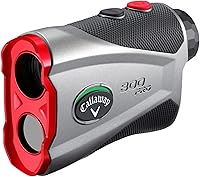
The Callaway 300 Pro has an external slope switch, so turning slope off takes one move. Its flag lock works up to 300 yards, which covers approach shots.
Our Callaway 300 Pro review has the full breakdown.
A compact Bushnell for walkers
The A1-Slope is the smallest of the four, and Bushnell says its battery lasts 50-plus rounds. It toggles slope with the mode button instead of an external switch.
A larger body with a built-in magnetic strip
The Series 3 Max+ is the largest of the four. Blue Tees includes a lanyard, a weather-proof carrying case and a USB-C to USB-A charging cable.
How do the four examples compare side by side?
The A1-Slope is the smallest, the Blue Tees is the largest, and the Callaway is the only one that isn't described as rechargeable. The REDTIGER and the A1-Slope both charge over USB-C.
| Unit | Size (in) | Slope control | Power | Carry |
|---|---|---|---|---|
| Bushnell A1-Slope | 3.75 x 1.42 x 2.36 | Mode button | USB-C rechargeable | BITE magnetic skin |
| REDTIGER | 4.17 x 1.61 x 2.36 | On/off switch | USB-C rechargeable | Magnetic strip and belt clip |
| Callaway 300 Pro | 4 x 2.7 x 1.4 | External switch | Lithium battery | Magnahold cart magnet |
| Blue Tees Series 3 Max+ | 4.61 x 1.61 x 2.99 | Slope switch | Rechargeable, USB-C cable | Built-in magnetic strip |
Start with the column that matters most to you, such as size for walkers or power for anyone who forgets to charge. The table leaves out magnification and range, since they are close enough that they rarely decide a first purchase.
Should a beginner buy a general laser instead of a golf model?
Choose a golf model when you want flag lock and slope. A general-purpose laser may not have those features, so check before you buy.
Our golf vs hunting rangefinder comparison lays out the differences in plain terms. It helps you avoid buying a unit made for another job.
Is a golf rangefinder worth it for a beginner?
It can be, if you want faster distances and the rules at your events allow the device. It helps most when judging the distance to a flag by eye is hard from where you stand.
Whether it's worth it depends on how often you play and which features you'll use. Our look at whether a golf rangefinder is worth it walks through who gets the most from one.
What mistakes do first-time buyers make?
The common mistakes are buying features you won't use, skipping the mount check and trusting a spec that a maker states two ways. Each is easy to avoid if you settle the basics first.
It's easy to buy the longest range or the most modes and then use only the flag lock. Match the features to your course before you match them to the box.
The mount check comes next. A magnet needs a metal bar, and a strap needs a rail that fits, so look at your cart frame or bag before you order.
The last mistake is trusting a spec that shows up two different ways. When a range, magnification or battery figure looks inconsistent, confirm it in the manual before you rely on it.
How do you get comfortable with your first rangefinder?
Practice the flag lock and the slope switch before a round that counts. A first unit takes a few rounds to feel natural, so early rounds are the time to learn the buttons.
Here's a simple warm-up:
- Set the slope switch to the setting you plan to use.
- Aim at a flag on the practice green from two or three distances.
- Watch for the lock cue, whether that's a vibration or a ring.
- Compare the reading with a yardage marker on the course.
The step-by-step is in our guide to using a golf rangefinder. Read it before the first round so the controls are familiar.
Verdict: the best golf rangefinder for beginners is the one you'll carry and keep powered
Pick the REDTIGER if you want a rechargeable slope laser with a belt clip. Pick the Callaway 300 Pro if you want an external switch, a cart magnet and a hard case.
Pick the A1-Slope if size matters most, and pick the Blue Tees Series 3 Max+ if you want a built-in magnetic strip and don't mind a larger body. Pick a GPS unit if course maps matter more than a flag reading.
If you're unsure, settle slope and size first, since those two choices remove most of the list. Start with our golf rangefinder buying guide if you want every type of unit side by side.
Frequently asked questions
What is the best golf rangefinder for beginners?
There's no single best model, but a beginner is well served by a laser that's easy to aim, easy to carry and simple to keep powered. The four examples in this guide range from the compact Bushnell A1-Slope to the larger Blue Tees Series 3 Max+.
Do beginners need slope on a golf rangefinder?
Slope helps most on hilly courses, where it adjusts the distance for uphill and downhill shots, and a flat course gets little from it. Slope readings aren't allowed in a round unless the committee permits them, so choose a unit that lets you switch it off.
Is a GPS unit a better first choice than a laser?
A GPS unit shows course maps and front, center and back distances, while a laser reads the distance to the target you aim at. If your main question is how far it is to the flag, start with a laser.
Should a beginner buy a rechargeable or battery-powered rangefinder?
Pick rechargeable if you'll remember to charge it, since you won't need to buy spare cells. Pick a replaceable-battery unit if you'd rather carry a spare and swap it on the course, and note the cell type before you shop for one.
Can a beginner use a golf rangefinder in a competition?
The Rules of Golf allow distance-measuring devices by default, but a committee can ban them with a local rule. Slope readings aren't allowed in a round unless the committee permits them, so check the local rule before a round that counts.