Best Golf Rangefinders for Seniors and Older Golfers
The best golf rangefinders for older golfers include the Nikon COOLSHOT PROII Stabilized for a steadier view with visual and audio lock cues, the Bushnell Tour V6 Shift Golf Rangefinder for a flashing ring and vibration on the lock, and the Voice Caddie VC4 Talking Golf GPS for a spoken yardage on every shot.
On this page (15 sections)
- The 6 best golf rangefinders for seniors in detail
- Side by side: type, feedback and slope
- How we picked these six rangefinders for seniors
- Readable numbers and a clear display
- Range and accuracy: what the numbers mean on a long hole
- Lock cues: how each unit tells you it has the flag
- What stabilization does and does not change
- Straps, cases and carrying on the course
- Batteries and charging
- Slope switch or automatic slope
- Setting up for an easy first round
- Questions to ask before you order
- Which pick fits how you play
- Who should skip each pick
- Which golf rangefinder for seniors should you buy
The best golf rangefinder for seniors is one with clear numbers, a lock cue you can see or feel, and controls that are easy to use on every hole. Those three things matter more than extra screens or features.
We compared six units from Nikon, Bushnell, Callaway, Blue Tees, REDTIGER and Voice Caddie on what you can read and feel. If rangefinders are new to you, start with how to use a golf rangefinder, step by step.
Then read how to choose your first golf rangefinder before you pick a model. For every rangefinder type, see the complete buying guide.
Our picks at a glance
-
1
 Best for a steadier view with visual and audio lock cues
Nikon COOLSHOT PROII Stabilized
8.9/10 our score
See it on Amazon -
2
 Best for a flashing ring and vibration on the lock
Bushnell Tour V6 Shift Golf Rangefinder
8.8/10 our score
See it on Amazon -
3
 Best for a spoken yardage on every shot
Voice Caddie VC4 Talking Golf GPS
8.5/10 our score
See it on Amazon
- 4
 Check it
REDTIGER Golf Rangefinder With Slope
Best for a transflective display and USB-C charging - 5
 Check it
Callaway 300 Pro Golf Laser Rangefinder
Best for a pulse burst and a cart magnet - 6
 Check it
Blue Tees Series 3 Max+ Golf Rangefinder
Best for a display that changes color with the light
The 6 best golf rangefinders for seniors in detail
The Nikon COOLSHOT PROII Stabilized leads this list because it pairs stabilization with a visual and audio lock cue. The other five each win on one point, from a spoken yardage to a display that changes color with the light.
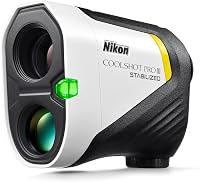
Nikon COOLSHOT PROII Stabilized
- Stabilization that steadies the view and laser, Nikon says
- Dual Locked On Echo visual and audio cue
- Hyper Read laser in 0.3 seconds or less
- OLED display
Stabilization that steadies the view and the ranging laser, Nikon says. The COOLSHOT PROII also gives a visual and audio cue when it locks onto the flag.
Pros
- Stabilization steadies the view while you range
- Visual and audio cue confirms the flag, Nikon says
- Nikon gives a 5-year manufacturer warranty
Cons
- Runs on a disposable CR2 battery rather than a charging port
- Nikon doesn't describe a slope on/off control
The COOLSHOT PROII Stabilized is a laser with stabilization that Nikon says steadies the view and the ranging laser. Nikon names an OLED display and says the Hyper Read laser returns a measurement in 0.3 seconds or less.
Its Dual Locked On Echo gives a visual and audio cue when you have the flag and not something behind it. The ID technology adjusts for incline and decline, so you get a plays-like number on hills.
It runs on a disposable CR2 battery that comes in the box. Nikon gives a range of 8 to 1,200 yd and a 5-year manufacturer warranty.
If you want more on stabilization, see the image stabilization picks. Other Nikon models are on the Nikon Sport Optics site.
Bushnell Tour V6 Shift Golf Rangefinder
- Visual JOLT with a flashing red ring
- PinSeeker vibration on lock
- External slope switch
- BITE magnetic cart mount
A flashing red ring and a vibration confirm the lock on the Tour V6 Shift. Bushnell adds an external slope switch and a 1,300 yd range.
Pros
- Flashing red ring and vibration confirm the lock
- 1,300 yd range with 6X magnification
- External slope switch that Bushnell says is easy to toggle
Cons
- Sits at the premium end of this list, so it costs more than the entry-level lasers here
The Tour V6 Shift gives you a lock cue you can see and feel. Visual JOLT flashes a red ring and vibrates when the laser locks onto the flag, and PinSeeker confirms the target.
It measures up to 1,300 yd with 6X magnification. Bushnell says its external slope switch makes it easy to toggle slope on or off.
The BITE magnetic mount sticks it to a cart bar or any metal surface, and the box includes a premium case, a microfiber cloth and a quick-start guide.
It's the premium-tier pick here, so it makes the most sense if you want the ring, the switch and the long range in one unit.
Voice Caddie VC4 Talking Golf GPS
- Voice output of distance
- Auto slope on green info
- Automatic course and hole recognition
- 40,000+ courses
A spoken yardage lets you hear the distance as you play. The VC4 is a GPS unit that covers more than 40,000 courses.
Pros
- Reads the yardage aloud as you play
- Automatic course and hole recognition
- Auto slope adds elevation data to the green info
Cons
- Voice Caddie quotes both 8 and 15 hours of battery life
- A GPS unit, so it reads from course data rather than the flag
The VC4 is a GPS unit, not a laser, with a voice output that reads the distance aloud. You can hear the yardage as you play, and the screen is there when you want to check it.
Auto slope adds elevation change data to the front and back distances. Automatic course recognition finds the course and hole you're playing, and the unit covers more than 40,000 courses worldwide.
It uses buttons and voice control rather than a touchscreen. Voice Caddie quotes both 8 and 15 hours of battery life.
If you'd rather wear a GPS on your wrist, see the best golf GPS watches.
REDTIGER Golf Rangefinder With Slope
- Transflective LCD display
- Flag pole lock with vibration
- Slope on/off switch
- USB-C charging
A transflective LCD display, which REDTIGER says keeps numbers clear, anchors this laser. The unit also has a slope on/off switch and USB-C charging.
Pros
- Transflective LCD display, which REDTIGER says keeps numbers clear
- Magnetic belt clip and magnetic strip give two ways to carry it
- 2-year assurance and lifetime technical support
Cons
- Six measuring modes mean more settings to learn than a single reading
- REDTIGER gives both 1,000 yd and 1,200 yd for its range
The REDTIGER is a laser with a transflective LCD display, which REDTIGER says keeps the numbers clear and quick to read. It has a flag pole lock with vibration, and you can switch its slope on or off.
It has 7X magnification and six measuring modes, so there are more settings to learn than on a unit that gives a single reading.
A magnetic belt clip lets you carry it on your belt or golf bag, and a magnetic strip sticks it to a cart. It charges over USB-C.
REDTIGER promises a 2-year assurance with lifetime technical support, and gives its range as both 1,000 yd and 1,200 yd. Read our REDTIGER review for the full spec list.
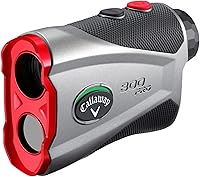
Callaway 300 Pro Golf Laser Rangefinder
- Pulse vibration burst
- Pin Acquisition Technology lock to 300 yd
- External slope on/off switch
- Magnahold cart mount
A pulse burst confirms the pin lock, and the external slope switch sits on the body. Callaway says the switch lets you play competition rounds with slope off.
Pros
- Pulse burst confirms the pin lock
- Magnahold holds the unit to a cart frame
- Battery included in US units
Cons
- Pin lock works up to 300 yd, Callaway says
- A vibration is the only lock cue Callaway describes
The Callaway 300 Pro is a laser with a Pulse feature that sends a short vibrating burst when it locks onto the pin. Its Pin Acquisition Technology locks onto the pin up to 300 yd away.
The external slope on/off switch sits on the body, and Callaway says it lets you play competition rounds with slope off. The unit reads in yards or meters and has 6X magnification.
The Magnahold cart mount holds it to a cart frame, so it stays within reach between holes. US units come with a battery included.
It comes with a molded hard case, a carabiner and a quick-close band. See our Callaway 300 Pro review for the case and lock details.
Blue Tees Series 3 Max+ Golf Rangefinder
- Auto-ambient red or black display
- Flag Lock vibrating pulses
- Slope switch
- Built-in magnetic strip
A display that switches between red and black to contrast with the light, Blue Tees says. The unit also has a slope switch and a built-in magnetic strip.
Pros
- Display text switches between red and black for the light
- Vibrating pulses confirm the lock
- Weatherproof case, cloth and lanyard in the box
Cons
- Blue Tees gives the magnification as both 6X and 7X
The Series 3 Max+ is a laser whose display text switches between red and black to suit the light. Blue Tees says its Auto-Ambient setting adjusts the text to contrast with the lighting.
Flag Lock sends short vibrating pulses to confirm you have the flag and not what is behind it. The unit also has a slope switch and a built-in magnetic strip for the cart.
The range is 1,000 yd with plus or minus 1 yd accuracy. Blue Tees gives the magnification as both 6X and 7X.
The box includes a weatherproof case, a microfiber cloth and a lanyard.
Side by side: type, feedback and slope
Five units here are lasers, and the Voice Caddie VC4 is the only GPS unit with voice output. The Feedback row matters most here, since it shows how each unit confirms a lock.
| Product | Best for | Type | Feedback | Slope | Our score |
|---|---|---|---|---|---|
| Nikon COOLSHOT PROII Stabilized | a steadier view with visual and audio lock cues | Laser, stabilized | Visual and audio cue | Incline and decline (ID) | 8.9 |
| Bushnell Tour V6 Shift Golf Rangefinder | a flashing ring and vibration on the lock | Laser | Flashing ring and vibration | External slope switch | 8.8 |
| Voice Caddie VC4 Talking Golf GPS | a spoken yardage on every shot | GPS with voice | Spoken distance | Automatic slope | 8.5 |
| REDTIGER Golf Rangefinder With Slope | a transflective display and USB-C charging | Laser | Flag lock vibration | On/off switch | 8.3 |
| Callaway 300 Pro Golf Laser Rangefinder | a pulse burst and a cart magnet | Laser | Pulse vibration burst | External on/off switch | 8.1 |
| Blue Tees Series 3 Max+ Golf Rangefinder | a display that changes color with the light | Laser | Vibrating pulses | Slope switch | 7.8 |
Only the Nikon pairs a visual cue with an audio cue. The Tour V6 Shift adds a flashing ring to its vibration, and the VC4 speaks the number instead of confirming a lock.
How we picked these six rangefinders for seniors
We compared specs and features, then scored each unit on readability, lock cues, stabilization and controls. Our score weighs specs, features and buyer feedback against what you're shopping for.
We put the most emphasis on how each unit confirms a lock, since a clear cue helps on any hole. Mounts and carry came next, followed by the slope setting and battery.
Price tier did not move any score.
Readable numbers and a clear display
Four units take different routes to a readable number: the Nikon names an OLED display, the REDTIGER a transflective LCD, the Blue Tees a text color that switches between red and black, and the VC4 speaks the number.
REDTIGER says its LCD keeps numbers clear and quick to read. Blue Tees says its Auto-Ambient text adjusts to contrast with the lighting.
Pick the one whose number you take in fastest, whether that is a screen, a ring or a spoken yardage.
Nikon's stabilization is meant to steady the view, so the flag stays still in the frame while you range.
Range and accuracy: what the numbers mean on a long hole
Most flags you range sit well inside 300 yd, so range is rarely the deciding number. The Tour V6 Shift reaches 1,300 yd, the Nikon gives 8 to 1,200 yd, and the Callaway and Blue Tees reach 1,000 yd.
REDTIGER gives both 1,000 yd and 1,200 yd, so treat its range as at least 1,000 yd.
On a 150 yd approach, a 1 yd error is less than 1 percent of the distance, so a clean lock often matters more than the decimal.
REDTIGER gives its accuracy as 0.5 yd, while Callaway and Blue Tees both say plus or minus 1 yd. Those are the brands' own figures, so treat them as claims.
Lock cues: how each unit tells you it has the flag
Four of the six give a vibration or a pulse, and the Nikon and Tour V6 Shift add a visual cue. The VC4 is the exception, since it speaks the distance rather than confirming a lock.
Golf rangefinder for seniors: lock cues and feedback
A lock cue works best when it is the one you notice first, so try the vibration or ring on the range before you play. Try it with the gloves you wear on the course.
Both the Blue Tees and REDTIGER pair a vibration with the flag lock, so you have one cue to learn. The Callaway's pulse burst works the same way.
The Nikon pairs its visual cue with an audio cue, which gives you a second signal if the ring is hard to see in glare.
What stabilization does and does not change
Stabilization is the Nikon's main feature for a steadier view. Nikon says it counters movement and other environmental factors, so the view and the ranging laser stay steadier while you range.
Stabilization describes how the view holds still, not how far the laser reaches. Compare range and accuracy separately, since the Nikon's 8 to 1,200 yd range is a different question from how steady the picture looks.
The Tour V6 Shift and Callaway do not name stabilization, but they confirm the lock with a flashing ring or a pulse burst. If a steadier view is your top priority, the Nikon is the pick in this post.
Straps, cases and carrying on the course
If you walk 18 holes, check the size and the case before you buy, since you carry the unit all day. The product pages list dimensions, so compare them with the pocket or bag you plan to use.
The Nikon comes with a wrist strap, and the Blue Tees ships with a lanyard and weatherproof case. The REDTIGER adds a hand rope, a belt clip and a soft case, and the Callaway's hard case has a carabiner.
On a cart, the Tour V6 Shift has a BITE magnet, the Callaway uses a Magnahold, and the Blue Tees has a built-in strip. The REDTIGER has a magnetic strip as well.
Batteries and charging
The Nikon uses a disposable CR2, and the REDTIGER and Blue Tees charge over USB-C. The Tour V6 Shift and Callaway come with a battery in the box, so they work on the first day.
Voice Caddie quotes both 8 and 15 hours of battery life for the VC4, so plan a charge before a long round. Nikon's battery is disposable, so keep a spare on hand for a multi-day trip.
Charge the unit the night before, and keep the USB-C cable in the bag so the unit is ready on the first tee.
Slope switch or automatic slope
Four lasers here have a slope switch, the VC4 adjusts slope automatically, and the Nikon uses ID technology for incline and decline. A slope switch lets you choose the setting each round, and that choice can matter in events.
The Nikon and VC4 adjust without a switch, which keeps the setup simple. Neither maker says whether the slope can be turned off, so pick a unit with a switch if you play events.
If you don't need slope at all, a plain laser keeps the setup short, and you can ignore the slope row in the table.
The Rules of Golf allow distance measuring by default, but a committee can prohibit it, and slope readings aren't allowed in a round unless the committee permits them. Check the local rule, and note that the USGA publishes the Rules of Golf.
The slope versus no-slope comparison explains when each setup helps, and the best golf rangefinders with slope lists more models.
Setting up for an easy first round
Charge the unit, pick yards or meters, and practice the lock before you tee off.
The Callaway 300 Pro reads in yards or meters, so set your preference before you play.
If the unit has a slope switch, choose the setting before the round and keep it the same for every hole.
The VC4 recognizes the course and hole on its own, so you can start a round without searching through menus.
Practice the lock on a range flag or a nearby pin, so you feel the vibration or see the ring before it matters.
Read through the buttons or the menu once at home, so the first round is spent on the golf rather than the settings.
Questions to ask before you order
Ask whether you can read the number in bright light, whether the lock cue is one you notice, and whether the unit suits how you carry it. Those three questions cover most of the difference between these six.
Look at the display first, since the REDTIGER's transflective LCD and the Blue Tees' Auto-Ambient text both aim to keep the number clear in changing light.
Then check the lock cue, because a vibration, a ring or a spoken yardage each confirms the reading in its own way.
Finally, check the size and the mount, since a unit you carry all day should feel right in your hand.
Which pick fits how you play
Walkers should check the size and the case, cart riders can take a unit with a magnet, and golfers who play events should look for a slope switch.
Walkers can take the REDTIGER, since its belt clip keeps the unit on your belt or bag, or the Nikon, which comes with a wrist strap.
Cart riders can take the Tour V6 Shift, since its BITE mount sticks to a cart bar.
Golfers who play events should pick a unit with a slope switch, such as the V6 Shift, Callaway, REDTIGER or Blue Tees, so the slope setting is theirs to choose.
Golfers who want a spoken number should look at the VC4, which reads the yardage aloud on every shot.
Who should skip each pick
Skip the Tour V6 Shift if you want an entry-level price tier, skip the VC4 if you want a flag reading, and skip the Nikon if you want a charging port.
The VC4 gives distances from course data, so it will not match a laser on a flag tucked behind a hazard.
The Nikon runs on a disposable CR2, so pick a rechargeable unit such as the REDTIGER or Blue Tees if you'd rather charge than swap a cell.
The REDTIGER has six measuring modes, so skip it if you want the fewest settings. The Callaway describes a vibration only, so skip it if you want a visual cue as well.
Skip the Blue Tees if you need a settled magnification figure, since it gives both 6X and 7X.
Which golf rangefinder for seniors should you buy
Pick the Nikon COOLSHOT PROII Stabilized for a steadier view with visual and audio cues, or the Tour V6 Shift if you want a flashing ring, a vibration and a slope switch.
Pick the Voice Caddie VC4 if hearing the yardage matters most and a GPS unit suits you. Pick the REDTIGER if you want a laser with a transflective display and USB-C charging.
Pick the Callaway 300 Pro if a pulse burst and a cart magnet matter most. Pick the Blue Tees Series 3 Max+ if a display that changes color with the light matters most.
After you choose, check the slope setting, the lock cue and the mount at home before your first full round. For the value angle, read the best golf rangefinders for the money.
Our top 3 picks at a glance
-
1
Best for a steadier view with visual and audio lock cues
Nikon COOLSHOT PROII Stabilized
8.9/10 our score
See it on Amazon -
2
Best for a flashing ring and vibration on the lock
Bushnell Tour V6 Shift Golf Rangefinder
8.8/10 our score
See it on Amazon -
3
Best for a spoken yardage on every shot
Voice Caddie VC4 Talking Golf GPS
8.5/10 our score
See it on Amazon
Frequently asked questions
What is the best golf rangefinder for seniors?
The Nikon COOLSHOT PROII Stabilized is our top pick, since it pairs a steadier view with visual and audio lock cues. The Tour V6 Shift suits a golfer who wants a flashing ring and a slope switch, while the VC4 suits a spoken yardage.
Do golf rangefinders read the distance out loud?
Yes, the Voice Caddie VC4 reads the yardage aloud and adjusts for slope automatically, and it covers more than 40,000 courses. It is a GPS unit rather than a laser, so it reads distances from course data rather than from the flag itself.
Is a stabilized golf rangefinder worth it?
It can be, if a steadier view matters more to you than the other features. Nikon says stabilization steadies the view and the ranging laser, and the COOLSHOT PROII is the only unit here that names stabilization, so it is the one to pick if that matters most to you.
Which golf rangefinder display is easiest to read in changing light?
The REDTIGER's transflective LCD and the Blue Tees' Auto-Ambient text are the two lasers here that aim to keep numbers readable in changing light. REDTIGER says its LCD keeps numbers clear and quick to read, and Blue Tees says its text switches between red and black to contrast with the lighting.
Can you turn slope off on these rangefinders?
Four lasers here have a slope switch, including the Tour V6 Shift, Callaway 300 Pro, REDTIGER and Blue Tees, so you can choose the setting on those four. The Nikon and VC4 adjust slope automatically, and neither maker says whether that can be turned off.