How Does a Golf Rangefinder Work?
A golf rangefinder works by firing a short laser pulse, timing how long the light takes to bounce back, and turning that time into yards. Slope, flag lock and stabilization are extras built on top of that step.
On this page (10 sections)
- How does a golf rangefinder work when you press the button?
- What happens between the pulse and your screen?
- Why does the flag lock matter for the reading?
- How does slope change the number you see?
- What does the number tell you, and what doesn't it?
- Why does image stabilization help the view?
- How fast is a reading, and does speed matter?
- What makes a flag easier to read?
- What do scan mode and the other extra modes do?
- Which features to pick once you know how a golf rangefinder works
A golf rangefinder works by firing a short laser pulse at your target, timing how long the light takes to bounce back, and turning that time into a distance in yards.
Here's how a golf rangefinder does it, with no physics needed. Slope, flag lock and stabilization are extras built on top of that one step.
The complete buying guide covers every model type, while this page stays with the parts that make a reading possible.
How does a golf rangefinder work when you press the button?
A golf rangefinder sends one short pulse of laser light at the target and waits for it to bounce back. The unit times that round trip and converts the time into a distance, usually in yards.
Think of a ball thrown at a wall and caught on the bounce, except the ball is light and the wall is your flag. The timer inside the unit does the counting, and the number appears within a moment.
For the button presses in order, how to use a golf rangefinder, step by step walks through the routine.
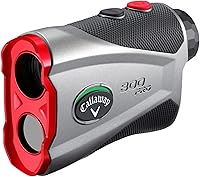
Callaway says its 300 Pro reads from 5 to 1,000 yards, within plus or minus 1 yard, in either yards or meters. Check the units setting before your first round.
What happens between the pulse and your screen?
The unit sends light out, a receiver catches the small return, and a processor turns the timing into yards. Each part has one job, and the whole cycle is too fast to see.
First, a pulse of laser light leaves the front lens and travels to the target. Most of that light scatters off the surface, and only a small share returns toward the unit.
A receiver inside the unit picks up the returning light and marks the moment it arrives. The gap between the outgoing pulse and the return is the number the device needs.
A processor converts that gap into a distance, then applies any slope or other adjustment the model has switched on. The display shows the result, and a vibration or red ring may confirm the lock on models that have one.
Why does the flag lock matter for the reading?
A flag lock keeps the reading on the pin instead of the tree or bunker behind it. It also gives you a signal, usually a vibration, so you know the lock happened.
How the lock works on a golf rangefinder
Callaway says its Pin Acquisition Technology locks onto the pin up to 300 yards away, and a short vibrating burst confirms the distance.
Bushnell describes a similar signal on the Tour V6 Shift, which flashes a red ring and vibrates once it locks onto the flag. That tells you the reading came from the target you aimed at, not something past it.
If the lock never confirms, the device may be reading something other than the pin. Aim again, and wait for the signal before you trust the number.
How does slope change the number you see?
Slope mode measures the angle of the shot and shows a second number that adjusts for it. Uphill shots play longer than the straight-line distance, and downhill shots play shorter.
Say the flag sits well above you. The straight-line number would leave you short, and the slope number tells you how the shot will really play, which can change your club.
Nikon says its ID technology gives you one number that accounts for an incline or a decline, so you don't work out the adjustment yourself.
Makers use other names too, such as slope compensation and slope adjusted distance. What is slope on a golf rangefinder? explains the number in more detail.
Many models have a switch that turns slope off, and on the Callaway 300 Pro it's an external slope on/off switch.
Distance measuring is allowed by default under the Rules of Golf, but a committee can prohibit it, and slope readings aren't allowed in a round unless the committee permits them. Are golf rangefinders legal? covers the rule in more detail, so check the local rule before you play.
What does the number tell you, and what doesn't it?
The reading gives you the distance to the target you locked, and nothing more. It doesn't pick the club, read the wind or predict how far your swing will carry the ball.
Take a fresh reading for each shot, because the lie, the wind and your usual distances still decide the club.
Why does image stabilization help the view?
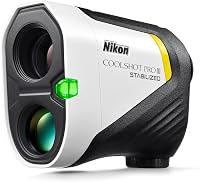
Image stabilization gives you a steadier view, which makes it easier to keep the laser on the flag. Nikon says its COOLSHOT PROII Stabilized counters hand shake and other environmental factors to steady both the view and the ranging laser.
A small tremor in your hands shows up as a jittery view through the lens, and higher magnification makes that shake easier to see. A steadier view matters most on long shots.
If a steadier view is your main concern, the best golf rangefinders with image stabilization compares more models side by side.
How fast is a reading, and does speed matter?
Speed depends on the model. Nikon says its COOLSHOT PROII reads in 0.3 seconds or less.
Speed matters most when you measure several targets in a row, like the flag, then a bunker, then the far edge of a green. The quicker the unit settles on each one, the less time you spend waiting over every target.
What makes a flag easier to read?
Reflective material on a flag sends more laser light back, so the reading comes faster and cleaner. A dull or dark target returns less light, and the device may take longer or show no number at all.
Distance matters too. A flag at 300 yards returns less light than one at 100 yards, so a far pin asks more of the device.
A hunting rangefinder uses the same laser idea, but its features are tuned for other targets. Golf rangefinder vs hunting rangefinder explains the differences that matter on a golf course.
What do scan mode and the other extra modes do?
Scan mode keeps measuring while you sweep across the view, so you can read the flag, then a bunker, then the edge of the green without pressing again. Other modes change what the number means.
REDTIGER's unit offers six measurement modes, including slope, flag locking and continuous scan, and a short press moves between them.
Which features to pick once you know how a golf rangefinder works
Pick the features that solve a problem you really have on the course, because each one answers a single question.
Pick a basic model if you only want the yardage. Pick slope if your course has real elevation changes, and pick flag lock if you want a clear signal on every pin.
Pick stabilization if a steady view is your biggest problem. Pick a model with a slope switch if you play events that may limit slope.
Is a golf rangefinder worth it? helps you decide whether the extras suit how often you play.
Frequently asked questions
How does a golf rangefinder measure distance?
It sends a short pulse of laser light at the target, then times how long the light takes to come back. The device turns that trip time into a distance, usually in yards, and shows it on the display within a moment.
Why does a rangefinder sometimes read the tree behind the flag?
When a tree or bunker sits in the same line as the flag, the laser can return from that object instead of the pin. Aim at the flag, hold steady, and wait for the flag-lock confirmation, usually a vibration, before you take the number.
What does slope do on a golf rangefinder?
Slope mode measures the angle of the shot and shows an adjusted distance, with uphill shots playing longer and downhill shots playing shorter. Many models let you turn slope off, and a committee decides whether slope readings are allowed, so check the local rule.
Does image stabilization make a rangefinder more accurate?
It gives you a steadier view, which makes the flag easier to hold while you take a reading. Nikon says its stabilization steadies both the view and the ranging laser, so compare each maker's stated accuracy figures before you decide.